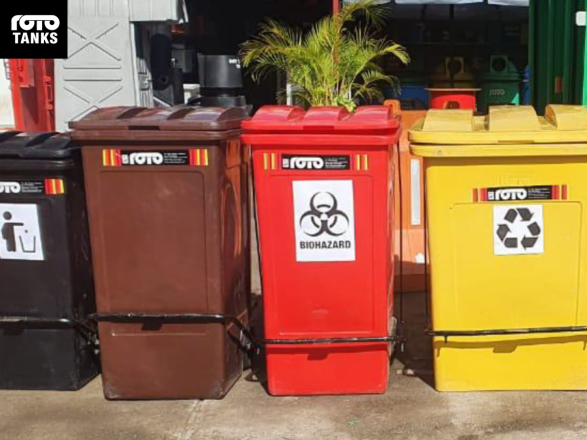
If you manage a school, estate, market, or commercial property in Kenya, overflowing waste is usually less about collection schedules and more about bin capacity. Small household bins fill quickly in high-traffic environments, leading to overstuffed rubbish bags, untidy compounds, and constant cleanup throughout the day. Large waste bins solve a practical problem that smaller containers simply cannot handle consistently.
A single 240-litre bin can hold significantly more waste than several standard household bins combined, which makes a noticeable difference in busy environments such as residential estates in Karen or schools in Westlands. Better capacity means fewer overflows, cleaner shared spaces, and a waste management routine that feels controlled rather than reactive.
What Size Counts as a “Large” Waste Bin?
This varies depending on who you ask, but practically speaking, large waste bins in Kenya start from around 120 litres and go up to 1,100 litres for communal or street-level use.
For most commercial settings – offices, restaurants, schools, and petrol stations – a 240-litre wheeled bin is the most practical choice. It is large enough to reduce emptying frequency and small enough to move without needing equipment. A compound with four or five of these placed strategically will stay clean between collections without becoming an eyesore.
Larger 660-litre or 1,100-litre skip-style bins are more suited to markets, construction sites, and county-managed collection points. If you are not sure what size your operation actually needs, think about your peak waste day, usually end of week, and work backwards from there.
Why Plastic Rotomoulded Bins Hold Up Better Than Metal
Metal bins rust. Anyone who has had galvanised bins sitting in a Nairobi courtyard for two rainy seasons already knows this. The bottom corrodes first, then the lid warps, then the whole thing becomes a leaking, odour-holding problem.
Rotationally moulded plastic bins, the type used by Roto Moulders, are a different material entirely. High-density polyethylene does not rust, does not absorb liquid, and handles UV exposure without cracking or fading badly. A well-made plastic bin on a Mombasa coast property will look roughly the same after three years as it did on delivery day.
They are also lighter, which matters when your staff are moving bins around a site or positioning them near service roads. No lifting injury risks from a bin that weighs 40kg empty.
Which Environments Need Large Waste Bins Most?
Schools are the obvious answer. A school with 400 students generates a substantial amount of waste daily: lunch packaging, paper, and food scraps. One or two small bins per classroom is not a waste management system; it is a plan to fail.
Residential estates in Nairobi, particularly gated communities in Kileleshwa, Lavington, or Syokimau, increasingly expect proper communal waste facilities as part of their management standards. Tenants notice. Property managers who ignore it tend to hear about it.
Markets and trading areas have perhaps the highest daily volume. Fruit and vegetable waste, packaging, and general litter accumulate fast. Without large, clearly positioned bins, it ends up on the ground.
Pairing Waste Bins with Garden Products: A Practical Outdoor Setup
Here is something most people do not connect: your outdoor space works better when both the functional and the aesthetic elements are planned together. Large waste bins, placed correctly, can actually sit alongside well-designed garden features without the compound looking cluttered.
Medium flower pots positioned near entrances add colour and a sense of care to a property. Modern garden planters along walkways create structure. Small rose planters by office entrances soften what would otherwise be a purely functional space. Medium palm pots do well in Kenyan climates. Palms are low maintenance, handle the heat, and look right in most settings, from Nairobi suburbs to coastal properties.
Roto Moulders produces a full range of home décor planters and garden products alongside its material handling range. Buying both from the same manufacturer keeps quality consistent and simplifies logistics considerably.
For a broader look at how Kenya’s environmental policy is shaping commercial waste management standards, the National Environment Management Authority (NEMA) provides guidance relevant to any property manager or business owner.
What to Check Before You Buy
A few things that matter more than price per unit:
Wall thickness is the first thing. Thin-walled bins crack under load or in direct sun. Ask for the material grade and wall spec before committing.
Lid fit matters for outdoor use. A lid that does not close properly lets in rain, which increases weight, breeds mosquitoes, and makes collection messier for everyone.
Wheel quality on larger bins (240L and above) is easy to overlook and expensive to regret. Cheap axles bend under a full load on uneven ground.
And consider colour coding if you are managing multiple waste streams: general waste, organic, and recyclable. It takes no extra effort when ordering, and it helps staff and users sort correctly without constant reminders.
Conclusion
Getting waste management right on a Kenyan property is less complicated than most managers make it. The right large waste bins, positioned sensibly, with the right capacity for your peak day, are most of the solutions. Add some decent garden planters to keep the space looking intentional rather than purely functional, and you have an outdoor environment that works on both levels.
If you are ready to sort out your bins and your garden in one go, take a look at what Roto Moulders have available. Good products, made locally, and delivered across Kenya.
FAQs
What is the most practical large waste bin size for a commercial property in Kenya?
For most offices, schools, and estates, a 240-litre wheeled bin is the right starting point. It handles significant daily volume, is easy to move, and fits standard collection vehicles.
How long do large plastic waste bins last in Kenyan conditions?
A quality rotationally moulded polyethylene bin should last eight to twelve years with normal use. UV stabilisation in the plastic is what makes the difference; bins without it start to fade, crack, and become brittle within two to three years in direct sun.