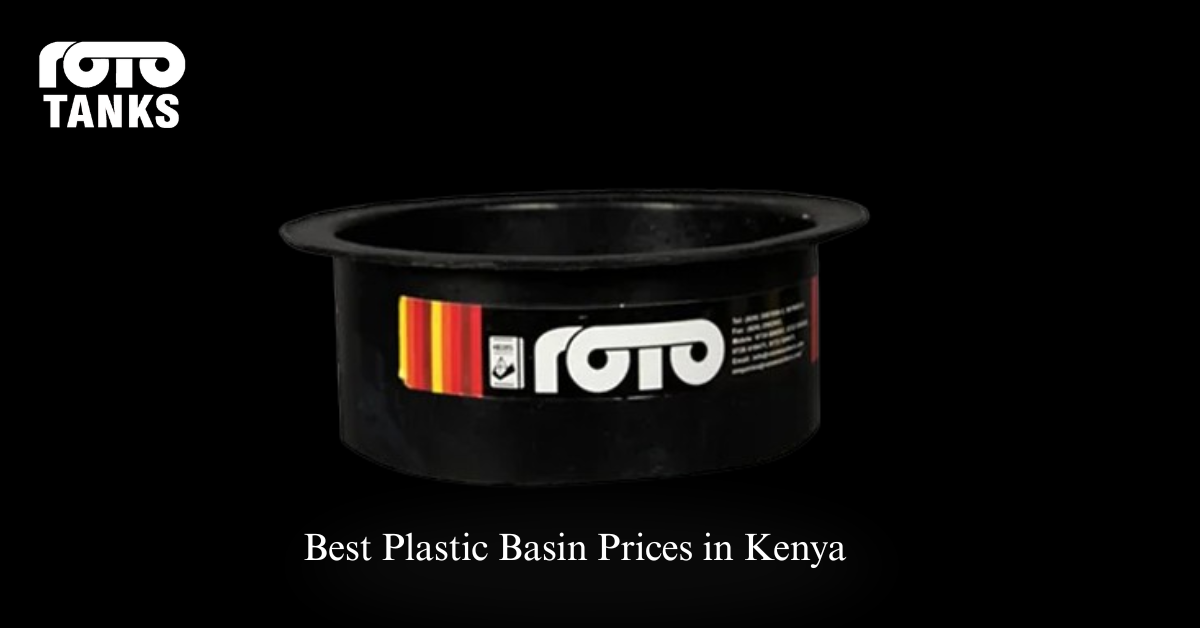
Most people buy a plastic basin without thinking too hard about it.
Then six months later it cracks, fades, or warps — and they are back to square one.
If you are going to spend money on plastic products, whether it is a small basin or a large storage tank, it makes sense to understand what actually separates a good buy from a waste of money. The best plastic basin prices in Kenya are not always the cheapest ones on the shelf.
What Drives Plastic Basin Prices in Kenya?
Price comes down to three things: material quality, manufacturing process, and wall thickness.
Basins made from virgin polyethylene cost more than those made from recycled plastic. But they last significantly longer, hold their shape in heat, and do not leach chemicals into anything stored inside them.
Rotational moulding — the process used by quality Kenyan manufacturers — produces a seamless one-piece product with no weak joints. A basin made this way will not split at the base after a few months of use.
Thin-walled, cheaply made basins might look identical in the shop. They rarely perform identically in your home or worksite.
Water Tanks Price in Kenya — What Should You Expect to Pay?
Water tank prices in Kenya vary widely depending on capacity, wall thickness, and whether the tank is UV-stabilised.
A household rooftop tank in the 2,000–5,000 litre range is the most common purchase. Prices differ between manufacturers, so what you want to compare is not just the number — it is what you get for that number.
Ask specifically:
- Is the polyethylene food-grade?
- Is it UV-stabilised for outdoor use?
- What is the manufacturer’s warranty period?
A tank without UV stabilisation will degrade in Kenya’s sun within a few years. A tank with it can last 20 years or more. That gap in lifespan makes a significant difference to the true cost of the purchase.
Hopper Tank Price in Kenya — Is It Worth the Premium?
A hopper tank has a conical bottom that funnels material — water, grain, feed, or chemicals — towards a central outlet at the base.
For farmers, feed mills, and industrial users, this design removes the need to tilt or manually empty the tank. Everything drains out cleanly through the outlet.
The hopper tank price in Kenya reflects that added engineering. You will pay more than you would for a standard cylindrical tank of the same capacity. But for operations where complete drainage matters — preventing contamination or spoilage at the base — it is not a premium you can easily avoid.
Sizes typically range from 500 litres to 5,000 litres. Confirm that the outlet fitting, valve, and stand are included or priced separately before you commit.
Monkey-Proof Bins Kenya — Why Ordinary Bins Fail
If you run a lodge, camp, resort, or any property near wildlife areas, you already know what happens to a standard bin overnight.
Monkeys and baboons are strong, persistent, and surprisingly good at working latches. A regular snap-fit lid is not much of a barrier.
Monkey-proof bins in Kenya are built with locking mechanisms that require opposing thumb movements to open — something primates cannot easily coordinate. The bins are also heavy-walled enough to resist being knocked over and dragged.
They are used across Kenya’s national parks, private conservancies, coastal resorts, and urban areas where wildlife encounters are a regular issue.
If you are managing waste in any of these environments, a standard bin is just an invitation. The right bin deals with the problem once.
Road Safety Equipment Suppliers — Getting It Right
Road safety products are one of those categories where buying cheap carries a real cost — not just financially, but in terms of actual risk to people.
Traffic cones, road barriers, water-filled jersey barriers, and bollards need to be visible, stable, and durable enough to survive vehicle contact, rain, and months of sun exposure.
Polyethylene road safety products hold their colour far better than painted alternatives. Paint fades and chips. Moulded colour does not.
When comparing road safety equipment suppliers, ask for Kenya Bureau of Standards (KEBS) compliance documentation. Any reputable supplier should provide this without hesitation. If they cannot, that tells you something worth knowing before you buy.
How to Compare Plastic Product Suppliers in Kenya
Not every supplier manufactures what they sell. Some are simply distributors of imported products with no quality control at the source.
A manufacturer who produces locally using rotational moulding has direct control over wall thickness, material grade, and finishing. They can also make custom sizes and configurations that an importer cannot.
According to the Kenya Bureau of Standards, plastic products used for water storage must meet specific material safety and hygiene requirements before they can be legally sold. Buying from a KEBS-certified manufacturer means you are not guessing about what is in your tank.
The Bottom Line
Whether you are buying a plastic basin, a water storage tank, a hopper, monkey-proof bins, or road safety equipment, the same principle applies.
The cheapest option is rarely the most cost-effective one.
Products that are properly manufactured, correctly certified, and built from quality materials last years longer — and that gap in lifespan is where the real money is saved.
If you want plastic products built to last in Kenya’s conditions, start with a manufacturer who actually makes them here.
FAQ
What makes a plastic basin worth buying in Kenya?
Look for basins made from virgin polyethylene, not recycled plastic. They resist cracking, hold their shape in heat, and do not discolour easily. A seamless rotationally moulded basin will outlast a cheaper injection-moulded alternative significantly.
How do water tank prices in Kenya compare between manufacturers?
Prices vary by capacity and material grade. Rather than comparing price alone, compare wall thickness, UV stabilisation, polyethylene grade, and warranty. Two tanks at the same price can have very different lifespans.
What size hopper tank do I need for a farm?
That depends on your storage volume and drainage requirements. A 1,000–2,000 litre hopper is common for small- to mid-sized agricultural use. For grain or feed storage, ensure the outlet diameter is wide enough to prevent blockages.
Are monkey-proof bins available in different sizes in Kenya?
Yes. They typically range from 120 litres for residential use to over 1,000 litres for commercial or hospitality properties. The key feature to confirm is the locking mechanism — not all bins marketed as “monkey proof” use the same standard.
What should I check when buying from road safety equipment suppliers?
Confirm KEBS certification, ask about UV resistance for outdoor use, and check whether reflective strips meet night-visibility requirements. Always request documentation rather than relying on verbal assurances.