

The importance of rainwater harvesting has been gaining momentum as an efficient way of managing water resources due to the constant problem of water scarcity, climate change and the increase in utility prices that continue to impact households and businesses. Rainwater harvesting systems encourage sustainability through the collection and storage of rainwater that can be used later, reducing reliance on mains water supplies. The storage tank is at the centre of any successful rainwater harvesting system, and in modern times plastic tanks have become an important aspect of ensuring that a harvesting system is reliable, affordable and practical.
This blog discusses the use of plastic tanks in rainwater harvesting systems, their advantages, the reasons why they are adopted instead of conventional materials, and why relied-upon manufacturers such as Rotomoulders provide efficient water storage solutions.
Understanding Rainwater Harvesting
Rainwater harvesting is the process that involves the collection of rainwater on rooftops, paved surfaces or any other surfaces and channelling the water in a storage tank. The water stored can then be employed for a large variety of non-potable purposes like irrigation in the garden, toilet flushing, washing vehicles, cleaning and agricultural activities. When properly filtered and treated, it may also be used as potable water.
The quality and design of the storage tank are key determinants of the efficiency of a rainwater harvesting system. Water contamination, leakage or structural failure could also occur because of poor design of the tank, making the whole system less effective. Plastic tanks have been found to be very reliable in this application.
Why Rainwater Harvesting Is Important Today
Water demand has kept rising as the natural sources of water are overexploited and hit by irregular weather patterns. Harvesting of rainwater presents a number of notable benefits:
It lessens the use of treated mains water.
It assists in reducing domestic and commercial water payments.
It minimises stormwater runoff, thus decreasing flood risks.
It helps in environmental conservation and sustainable living.
In order to make the most of these advantages, it is necessary to select the appropriate storage solution, and plastic tanks have become one of the most popular ones in this matter.
Why Plastic Tanks Are Ideal for Rainwater Harvesting
Most of the rainwater harvesting systems have plastic tanks as their major choice because they are better and more versatile as compared to traditional concrete and metal tanks. Plastic tanks are manufactured using advanced processes such as rotational moulding to make them tough, smooth and durable.
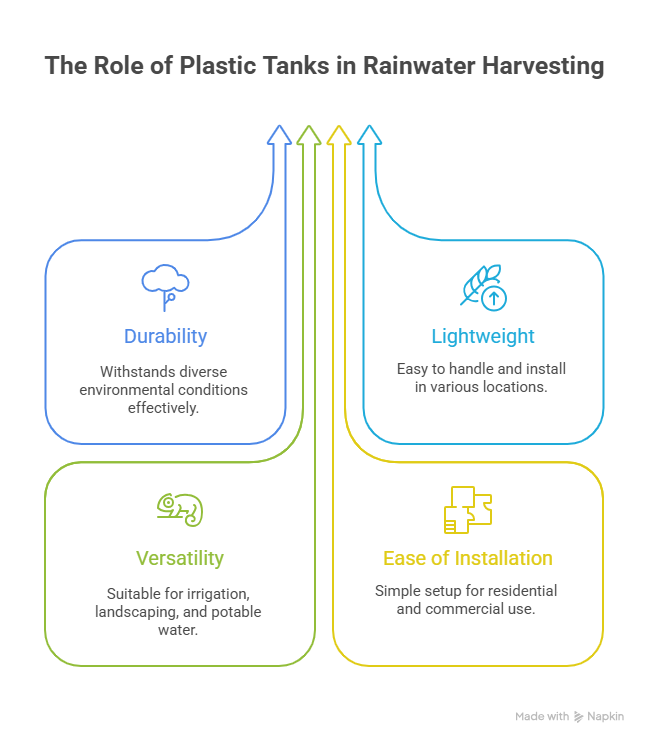
Plastic tanks, unlike the metal ones, do not rust or corrode, and unlike the concrete tanks, they are lightweight and easy to install. These features render them suitable for residential and commercial rainwater harvesting projects.
Key Benefits of Plastic Tanks
Durability and Strength
Plastic tanks are capable of resisting extreme environmental factors such as UV radiation, variation in temperatures, and heavy precipitation. Good tanks like those produced by Rotomoulders are made using UV-stabilised material, which does not crack and get degraded with time.
Portable and simple to install
Lightweight plastic tanks have been found to be among the greatest benefits of this kind of tank. This makes it much easier to transport, handle and install in comparison with concrete or steel tanks. Plastic tanks are easy to install in most instances, and it saves on the cost of the project because there is no need for heavy machinery.
Cost-Effective Solution
Plastic tanks cost less than the alternative materials and still have good performance and durability. Rainwater harvesting systems are cheaper to install and maintain, thus making them more affordable for homeowners and small businesses.
Minimal Maintenance Requirements
Plastic tanks have a smooth interior that does not allow proliferation of algae and formation of sediments. This also facilitates cleaning and ensures a better water quality. Plastic tanks can be used over many years with simple maintenance.
Flexible Design Options
Plastic tanks are presented in a great variety of shapes, sizes, and capacities. It is possible to tailor plastic tanks to almost any need, whether you need a slimline tank that can serve the small urban garden or a large-capacity tank that can serve agricultural purposes.
The Role of Rotational Moulding in Plastic Tanks
A technique known as rotational moulding is used to create many high-quality plastic tanks. The method forms continuous tanks of consistent wall strength, eliminating points of weakness and enhancing structural integrity.
Manufacturers such as Rotomoulders specialise in rotational moulding technology, making plastic tanks, which are strong, trustworthy and intended to store water over a long period. This type of manufacture makes sure that the tanks are able to manage the pressure of the stored water on the one hand, and on the other hand, the tanks are not subjected to the environmental pressures.
Rotomoulders and Quality Plastic Water Storage Solutions
Rotomoulders is a reliable brand in the market when it comes to high-quality plastic tanks for rainwater harvesting systems. Rotomoulders are known for their precision in engineering and dedication to quality and, as such, design tanks that fit the practical requirements of current water storage needs.
Rotomoulded plastic tanks have the features of reinforced walls, UV protection, and multiple inlet and outlet options. These properties have led to easier installation and efficient performance of the tank during its life period. Rotomoulded tanks have been designed to provide reliable performance whether applied in residential, commercial or farm applications.
Choosing the Right Plastic Tank for Rainwater Harvesting
The choice of plastic tank is an important process to consider in developing an efficient rainwater harvesting system. Before a decision is made, several factors are supposed to be put into consideration.
Rainfall Levels
Knowledge of the average rainfall in your locality serves to know how much water you can collect and save with certainty.
Catchment Area
The volume of rain that can be collected depends on the size of your roof or surface area.
Water Usage Needs
Take into consideration the use of the stored water. Irrigation of the garden does not need as much storage capacity as toilet water or commercial laundry water.
The Space Availability and Tank Capacity
Plastic tanks are available in different capacities, as small as a few hundred litres and up to a few thousand litres. Select the size that suits your water requirements and space.
Above-ground or below-ground installation
Plastic tanks can be installed either above or underground, and this gives them flexibility according to your location.
Experienced manufacturers such as Rotomoulders can provide an opportunity to obtain advice on what kind of tank suits your unique needs the best.
Installation and Maintenance of Plastic Tanks
The installation of a plastic rainwater tank needs to be done properly to enhance the full longevity and efficiency. The tank should be placed on a firm, level surface, either on a concrete slab or compact gravel. Proper location in the close vicinity of downpipes enhances the efficiency of water flow.
Maintenance requirements are minimal. Frequent cleaning of gutters and filters would ensure that no debris gets into the tank, and the inside of the tank is checked periodically to ensure the water is of high quality. Plastic tanks can be efficient for decades with very little maintenance.
Environmental Impact of Plastic Tanks
Plastic tanks also have a positive impact on environmental sustainability, as they are aiding the water conservation initiative. Using them allows us to decrease the reliance on the treated water reserves and decrease the energy costs related to the treatment and distribution of the water and its harvesting with the help of efficient water harvesting.
Moreover, a significant number of plastic tanks can be recycled when they are no longer needed, thus minimising the environmental effects when disposed of in a sustainable manner.